10:55ROPlt 12555 words
Czech Republic begins testing battery tram adapted for railway use
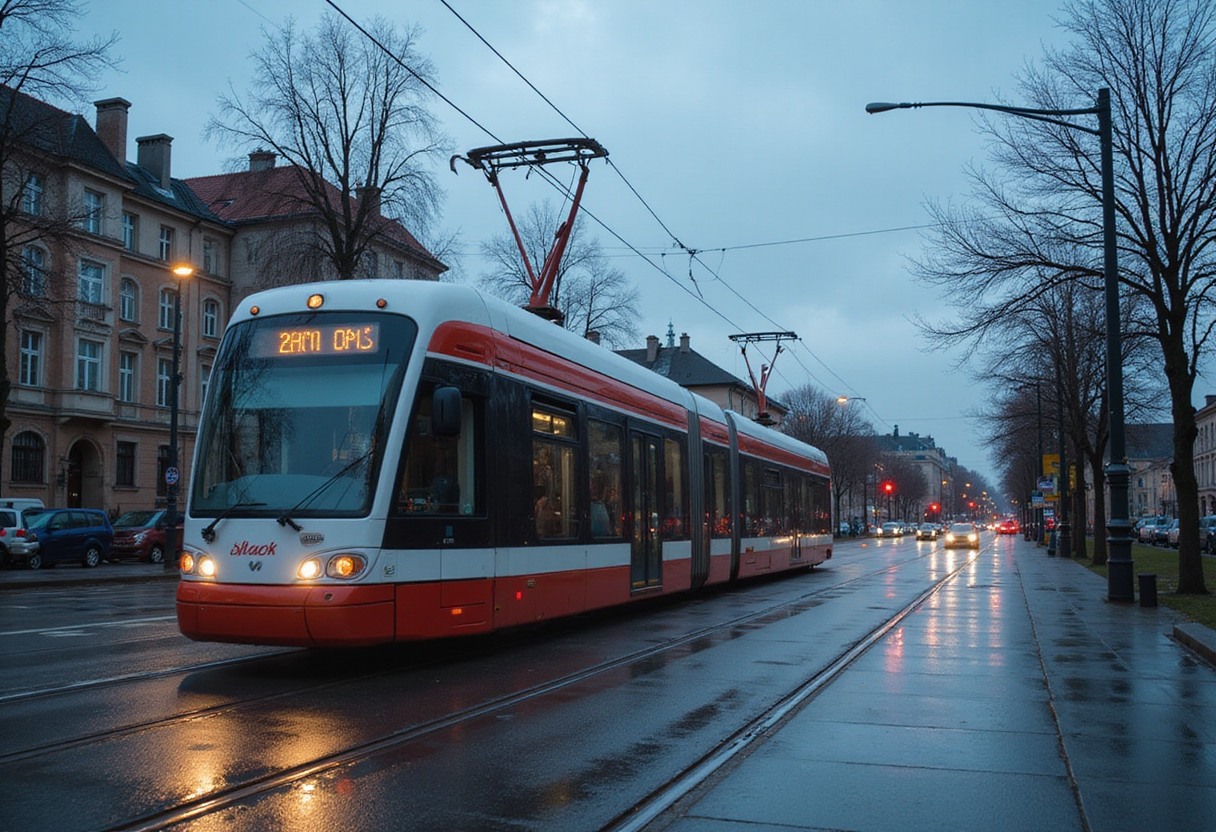
Czech Republic has begun testing a battery tram adapted for railway infrastructure, a trial with implications for tram-train operation on non-electrified lines.
· 3 min journey
Calling at
- The Czech Republic has begun testing a battery-equipped tram adapted for railway infrastructure.
- The vehicle uses onboard battery storage to operate on rail sections without overhead wires.
- No fleet order, delivery date or funding commitment has been announced with the trial.
- The test could support tram-train concepts linking Czech city tram networks with regional rail.
The Czech Republic has started testing a battery-equipped tram adapted to run on railway infrastructure, a trial that could reshape how lightly used regional lines and city street networks connect without full electrification.
The test programme, reported by Rollingstockworld, centres on a tram fitted with onboard battery storage, allowing it to operate over sections of the national railway network where no overhead contact wire exists. For operators, the appeal is straightforward: the vehicle draws power where catenary is available and switches to battery mode where it isn't, bridging gaps between tram lines and conventional rail.
The Czech Republic is a natural proving ground for this concept. The country runs dense tram networks in cities such as Prague, Brno, Ostrava and Plzeň, alongside an extensive regional rail network that includes routes without overhead lines. A vehicle certified to move between the two would let a single fleet serve both street track and mainline infrastructure — the basic premise behind tram-train operation already tried elsewhere in Europe.
What does the test actually change?
For practitioners, the key question isn't the battery itself — traction batteries are established technology in modern tram procurement — but the adaptation for railway infrastructure. Running on national rail network means meeting a different rulebook: signalling interfaces, platform heights, wheel profiles, crashworthiness requirements and interaction with heavier rail traffic.
A successful trial would signal that a standard tram platform, modified rather than redesigned, can clear those hurdles. That matters for cost. Purpose-built tram-train fleets have historically carried a price premium over conventional trams, and several European projects have struggled with certification timelines. If a battery tram can be adapted for rail use with incremental engineering, the business case for connecting city networks to commuter corridors improves.
Battery operation also changes the infrastructure equation. Battery tram-train concepts eliminate the need to erect catenary over shared sections — a cost driver on routes where clearance, bridges or heritage constraints make electrification expensive.
Why the Czech context matters
The trial aligns with a broader Central European interest in alternatives to full electrification on secondary lines. Regulators and operators across the region have examined battery and hydrogen options for branch routes where traffic volumes don't justify overhead line investment.
For Czech infrastructure managers, a tram capable of running on railway track opens options at the boundary between urban and regional networks: connecting a tram terminus to a nearby rail station, or extending tram services onto lightly used freight branches during passenger hours.
Claims to watch
As with any supplier or operator announcement, the trial result is the number that counts — range on battery power under load, recharge times at charging points, and certification milestones against the Czech rail regulator's requirements. Until those figures are published, the test remains a demonstration rather than a deployment decision.
No fleet order, delivery date or funding commitment has been announced in connection with the trial. The practical benchmark will be whether the adapted vehicle moves from test running to a regular-service pilot on a defined route, with published performance data.
If the trial succeeds, expect Czech operators and their counterparts in neighbouring markets to look hard at where battery trams could stitch urban and regional networks together — and at what the adapted vehicle costs compared with the electrification it would replace.
James Calloway, Mainline Report
via Google News: Rolling stock (Source)
More from James Calloway
Show full bio
Correspondent covering companies, deals and strategy in Rail industry news and analysis at Mainline Report.
333 articles
Connecting services · Related articles
- 14:35
Hungary Draws Up €10bn Rail Investment Plan
- 05:14
Battery power for commuter rail: the question Renewable Energy World puts to the industry
- 24:10
Metra's Battery-Electric Train Trial Aims at Diesel-Free Commuter Service
- 16:19
Stadler to develop hybrid locomotive for Swiss rack railway
- 02:50
Škoda Unveils Second-Generation Battery Electric Train at InnoTrans 2026