11:00INPlt 3635 words
Track laying begins on Nantong-Ningbo high-speed line
Xinhua confirms track laying has begun on the Jiangsu section of the Nantong-Ningbo high-speed railway, moving the Yangtze delta corridor toward systems works. No opening date was given.
· 3 min journey
Calling at
- Track laying has started on the Nantong-Ningbo high-speed railway, Xinhua confirmed.
- The milestone was reported on the line's section in Jiangsu province.
- The announcement gave no opening date, design speed or completion percentage.
- Track laying marks the shift from civil works to electrification, signalling and testing.
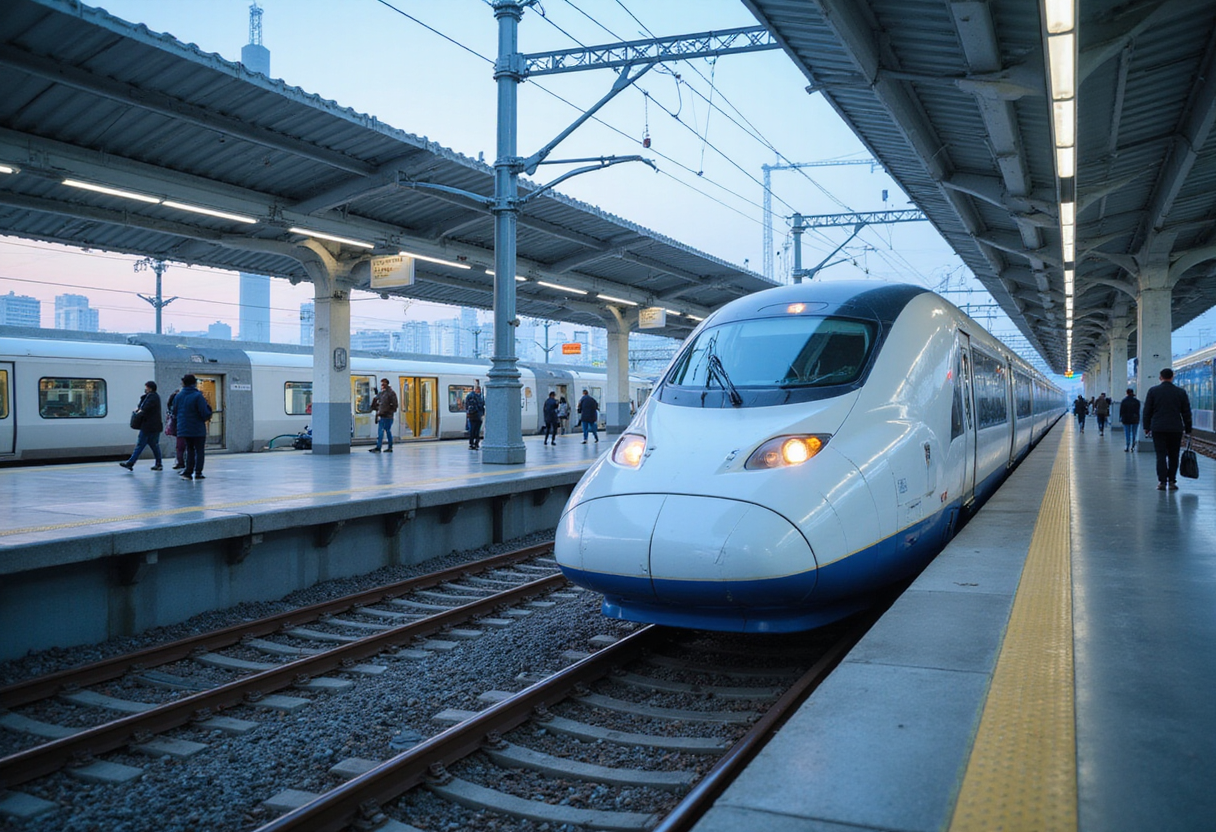
Track laying has started on the Nantong-Ningbo high-speed railway in the eastern province of Jiangsu, China's state news agency Xinhua has confirmed. The milestone shifts the project from civil-works preparation to the phase that determines opening dates: rail, slab and catenary installation.
Xinhua's dispatch is short. It names the line, the province and the fact of track laying. It does not state the kilometrage under track today, the share of the route now complete, or a target date for commissioning. Each of those gaps matters for anyone planning around this corridor, and none of them is filled by the announcement itself.
What is the Nantong-Ningbo line?
The project links Nantong, a Yangtze delta port city in Jiangsu, with Ningbo, the major deep-water port in neighbouring Zhejiang. Both cities sit on the coast south and east of Shanghai. A direct high-speed connection between them would shorten journeys that today run inland around the river and bay, tying two of China's busiest port economies into one rail corridor.
The start of track laying was reported from the Jiangsu section, which suggests the northern portion of the route is furthest advanced. That is a reading of sequence, not a claim from the source; Xinhua does not break down progress by province.
What does track laying actually signal?
In Chinese high-speed construction, track laying is a hard gate. Before it, a line is a series of viaducts, tunnels and embankments. After it, the project enters systems works: ballastless track completion, welding and stress dispersal, then electrification, signalling and integrated testing at speed. Openings follow testing campaigns that typically run for months.
For passengers and freight shippers, the operational meaning is straightforward. No track, no service date. Track in place narrows the uncertainty, though it does not close it: electrification and trial running remain, and Chinese projects have opened both ahead of and behind informal schedules.
What is not in the announcement?
Xinhua does not publish:
- a design speed for the line;
- the length of the section now under track;
- a percentage figure for overall completion;
- an opening year;
- the contractors performing the laying;
- the projected journey time between the two cities.
The absence of an opening date is the most consequential omission. State-media milestones on Chinese rail projects usually carry at least a commissioning window; this one does not. Readers should treat any date circulating elsewhere as projection until the operator or the national railway authority states one.
How the announcement should be read
Xinhua is the authoritative channel for construction milestones on national rail projects. When it reports that track laying has begun, the fact can be treated as confirmed. What remains unverified is everything downstream: the pace of the laying fronts, the handover to systems contractors, and the testing timetable. Suppliers of signalling and electrification equipment are the natural next checkpoint; their delivery and installation contracts tend to surface in the months after track crews move on site.
The economic framing also deserves restraint. A Nantong-Ningbo high-speed line would sit inside the Yangtze delta, the densest cluster of ports, industry and population in China. Faster rail links there compress business travel and shift freight and passenger flows. But the source carries no traffic forecast, no ridership model and no freight tonnage estimate, so any capacity figure a reader encounters belongs to earlier planning documents, not to this milestone.
A milestone that narrows, but does not set, the opening question
The Jiangsu section of the Nantong-Ningbo high-speed railway now has rail going down. That is the strongest fact available, and it is confirmed. The opening date, the journey time and the service pattern remain unconfirmed — until the railway's operator publishes them, every timetable in circulation is an estimate rather than a schedule.
via Google News: High-speed rail (Source)
More from Amara Osei
Show full bio
News editor covering technology and product news in Rail industry news and analysis at Mainline Report.
323 articles
Connecting services · Related articles
- 24:54
Xiong'an–Shangqiu line opens, bringing high-speed rail to 11 Shandong counties
- 22:33
New high-speed rail section to link Xiong'an, Shangqiu
- 07:43
China Opens Xiong'an–Shangqiu High-Speed Line
- 02:45
China opens four high-speed sections, extending world's largest rail network
- 10:18
High-speed line through central China's mountains enters service