02:45GLPlt 3544 words
China opens four high-speed sections, extending world's largest rail network
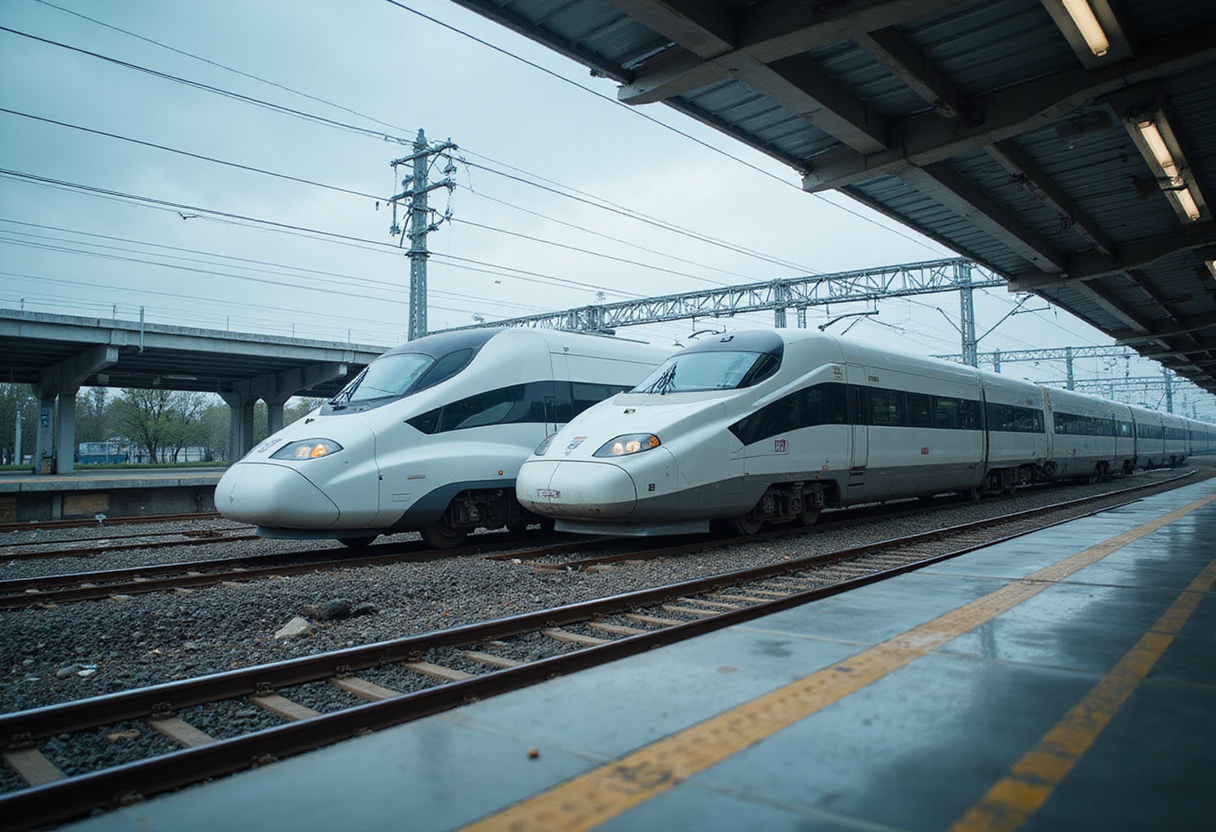
China has opened four high-speed railway sections across four regions, extending the world's largest network beyond 50,000 km and tightening one-hour commuting circles around major city clusters.
· 3 min journey
Calling at
- China opened four high-speed railway sections on Monday spanning northern, northwestern, central and northeastern regions.
- The network exceeded 50,000 km of high-speed rail in operation by the end of 2025, with a national target of 70,000 km by 2035.
- The Xiong'an-Shangqiu section fills the gap in Xiong'an New Area's southbound high-speed rail corridor, while the Harbin-Yichun line extends Harbin's two-hour transportation circle.
China has put four major high-speed railway sections into service, adding capacity across its northern, northwestern, central and northeastern regions and extending a network that already exceeds 50,000 route-km, the largest in the world as of the end of 2025.
The sections opened on Monday. China State Railway Group, the national operator, says the additions strengthen connections between major cities, city clusters and key economic zones — a claim consistent with the network's planned growth to 70,000 km by 2035 under national rail development plans.
Yuan Baohua, deputy director of China State Railway Group's construction department, said the opening supports concrete economic outcomes. "The opening of the four lines will promote industrial transformation and upgrading and cross-regional industrial transfer, boost the development of resources along the routes, and inject new momentum into coordinated regional economic and social development," Yuan said.
Each section binds specific regions more closely. The Xiong'an-Shangqiu section tightens links between Xiong'an New Area and central-southern Hebei, southwestern Shandong and eastern Henan. In the northeast, the Harbin-Yichun line extends the two-hour transportation circle centered on Harbin.
Liu Yanhong, deputy general manager of Xiong'an high-speed railway corporation, said the Xiong'an-Shangqiu section closes a gap in the new area's southbound high-speed corridor. The line facilitates commuting and business exchanges for relocated enterprises and institutions and supports industrial cooperation along the route — a service outcome tied directly to the government's relocation of Beijing-based functions to Xiong'an.
Ma Botao of the China Railway Economic Planning and Research Institute said the expanding network has shifted from isolated lines to an interconnected web, producing measurable travel-time effects across metropolitan regions. Commuting within metropolitan areas now takes roughly one hour, living and working across city clusters about two hours, and business travel between neighboring city clusters and provincial capitals around three hours.
"The railway network closely binds large and small cities, making industrial division of labor and cross-city employment the norm," Ma said.
The benefits extend beyond the corridors themselves, according to Ma. The Yichang-Xingshan section shortens effective distances not only between those two cities but also between the Chengdu-Chongqing region and the city cluster in the middle reaches of the Yangtze River.
For cities newly connected to the network, the economic payoff depends on positioning rather than the rails alone. Ma said large cities generally focus on research and development, finance and headquarters functions, while smaller cities should leverage agriculture, ecology, tourism and distinctive industries to host supporting manufacturing, agricultural product processing and wellness and cultural tourism — serving as industrial support bases and "leisure backyards" for central cities.
To convert transport advantages into development gains, Ma advised municipal governments to strengthen connections between high-speed rail stations and industrial parks and major population clusters, and to improve housing and public services to attract and retain talent.
China's high-speed network remains on a trajectory set by national planners: from more than 50,000 km in operation at the end of 2025 to a projected 70,000 km by 2035, with the four sections opened this week marking the latest step toward linking every major city cluster and economic zone in the country.
via Google News: High-speed rail (Source)