09:08ROPlt 9703 words
Stadler shows Flirt Nordic Express cars bound for Norway's long-distance routes
Stadler has shown four cars of the Flirt Nordic Express ordered by Norske Tog. First delivery is expected in January, with entry into service planned for 2028.
· 4 min journey
Calling at
- Norske Tog ordered 17 Flirt Nordic Express trainsets from Stadler in 2023: 13 EMUs and four electro-diesel sets with last-mile batteries.
- First delivery to Norway is expected in January, with entry into service in 2028 and all trainsets in service by 2030.
- The framework contract includes options for up to 100 trainsets, with Jernbanedirektoratet assessing potential additional orders.
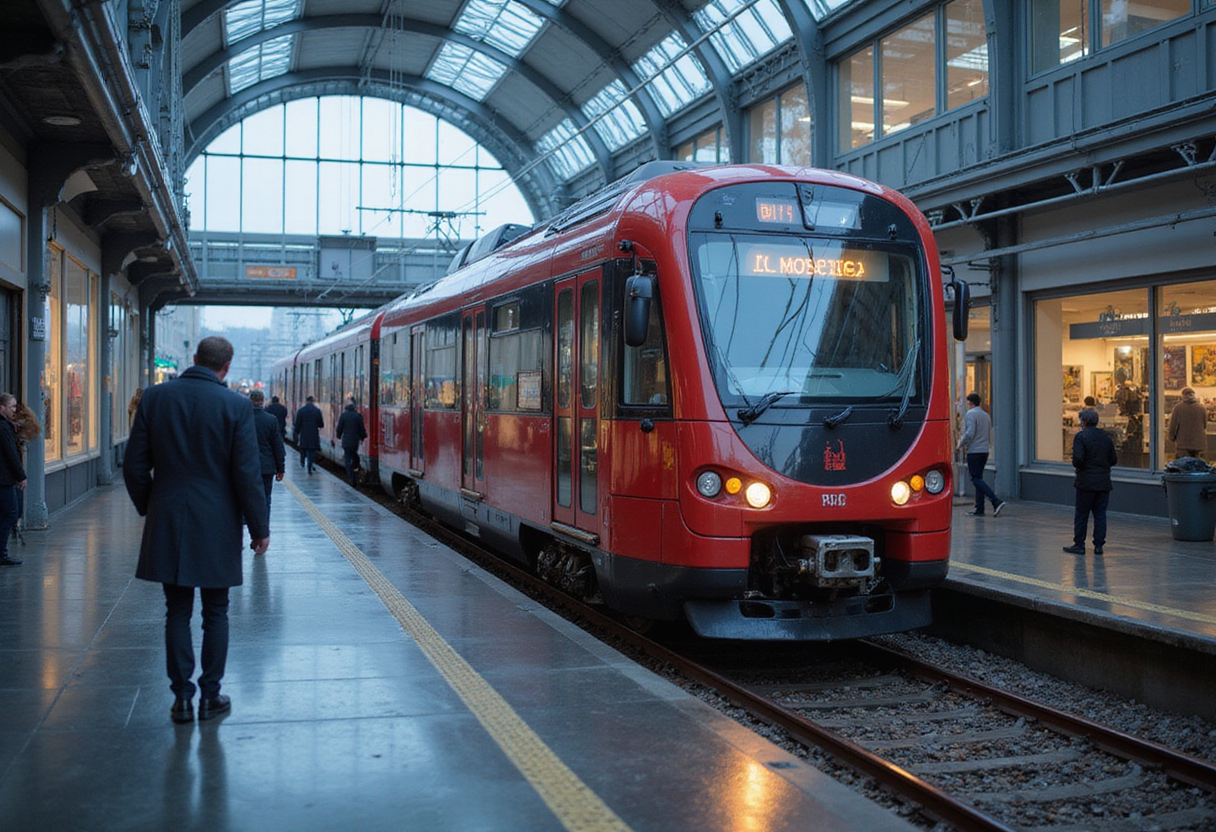
Stadler displayed four cars from a Flirt Nordic Express long-distance trainset at InnoTrans 2026, giving visitors a first close look at the fleet it is building for Norwegian state-owned rolling stock company Norske Tog under a contract signed in 2023.
The four cars on show came from the Type C daytime configuration: a bistro car, a family and play saloon, and two passenger cars fitted with both standard and reclining seating. The full trainsets will have eight cars each.
The 17-trainset order breaks down into 13 electric multiple-units and four electro-diesel sets, the latter also carrying a limited 'last-mile' battery capability. All will be approximately 220 m long with a maximum speed of 200 km/h.
From production to commissioning
The project is moving from vehicle production into commissioning and testing, Julian Zeitzmann, Norske Tog's Project Manager for the fleet, told Railway Gazette International at an InnoTrans preview event on August 19 at Stadler's Swiss sites in St. Margrethen and Altenrhein.
'Manufacturing and testing activities are progressing. The first vehicles are expected to be delivered to Norway in January next year for testing and approval before entry into service in 2028. All the trainsets are expected to be put into service by 2030', he said. He stressed that no precise date for deployment could yet be confirmed.
Zeitzmann said the fleet would work Norway's long-distance network. 'The trainsets, which feature a day into night configuration, will be deployed on all the long-distance routes in Norway', he confirmed. 'We are starting with the Bergensbanen (Oslo – Bergen), then the Sørlandsbanen (Oslo – Stavanger), Dovrebanen (Oslo – Trondheim) and Nordlandsbanen (Trondheim – Bodø).'
The procurement aims to renew Norway's long-distance passenger fleet and improve passenger experience, operational reliability and accessibility on long-distance services. The new trains are intended to replace several existing long-distance fleets that currently handle both daytime and overnight services.
Whether locomotive-hauled passenger services in Norway will disappear as a result remains an open question. 'Decisions regarding the future use, retention or retirement of existing rolling stock will be taken separately and are therefore outside the scope of the current procurement project', Zeitzmann pointed out. He called it 'premature to conclude whether the introduction of the new fleet will mark the end of locomotive-hauled passenger services in Norway. That will depend on future operational and fleet decisions.'
Options for up to 100 trainsets
The framework order included options for up to 100 trainsets. 'Potential additional train orders are currently being assessed by Jernbanedirektoratet [the government railway directorate] and other relevant stakeholders', Zeitzmann reported. 'Norske Tog has options available under the contract, but no decision on exercising additional options has been communicated so far.'
Passenger-facing features include reclining seats, accessible areas, larger bistro sections, and dedicated luggage and storage space for skis, bicycles and other large items — equipment choices that reflect the mix of leisure and overnight traffic on the routes the trains will serve.
Winterised and non-articulated
Stadler's Deputy CEO Ansgar Brockmeyer told Railway Gazette International that the Flirt Nordic Express differs substantially from the manufacturer's established regional Flirt family.
'It is a version of the Flint that is non-articulated, with different types of coaches that can be exchanged. There are seating, sleeping, bistro and luggage coaches. It is optimised for long-distance traffic', he explained.
The trains are designed for demanding Nordic winter conditions. Bespoke features include a reinforced front end with a strong snowplough and an underframe assembly built to shield the traction equipment from snow and ice. 'Compared to other trains manufactured by Stadler, the trainsets have enhanced thermal insulation', Brockmeyer added.
The four bi-mode trains will arrive as electro-diesel sets, but Brockmeyer predicted that the diesel powerpack could potentially be replaced by traction batteries in the future. 'There is already a last-mile battery onboard anyway, which is suitable for depot and station shunting, and capacity for approximately 9 km of running', he said.
The first trainsets are expected in Norway in January, marking the shift from assembly halls in St. Margrethen and Altenrhein to a testing and approval programme that must be completed before passengers board in 2028.
via Railway Gazette International (Source)
More from Rebecca Stone
Show full bio
Senior reporter covering business strategy at Mainline Report.
120 articles
Connecting services · Related articles
- 14:48
Stadler to show FLIRT Nordic Express for Norway at InnoTrans
- 13:15
Stadler to Unveil New FLIRT Akku at InnoTrans 2026
- 08:15
Stadler to build two electro-diesel rack locomotives for MVR
- 13:05
Stadler and ÖBB Unveil New KISS Double-Deck EMU
- 22:23
ÖBB and Siemens unveil Railjet M multiple-unit for Alpine routes