10:54INPlt 11703 words
Euroterminal Sławków signs €20m terminal expansion deal
Euroterminal Sławków signed a PLN 88 million (€20 million) deal for a five-hectare TK-2 expansion designed to add 198,925 TEU annually, with work due to start in early 2027.
· 4 min journey
Calling at
- Euroterminal Sławków signed a PLN 88 million (€20 million) TK-2 contract on 16 November with NDI and NDI Sopot.
- The five-hectare expansion includes about four kilometres of railway tracks for access and shunting.
- Planned capacity of 198,925 TEU annually would lift nominal capacity from approximately 285,000 to 483,925 TEU.
- NDI was selected in October 2026; construction is due around the end of Q1 2027, with completion planned for 2028.
- About €17 million in EU FEnIKS funding supports the roughly €43 million programme, while 26 jobs are expected.
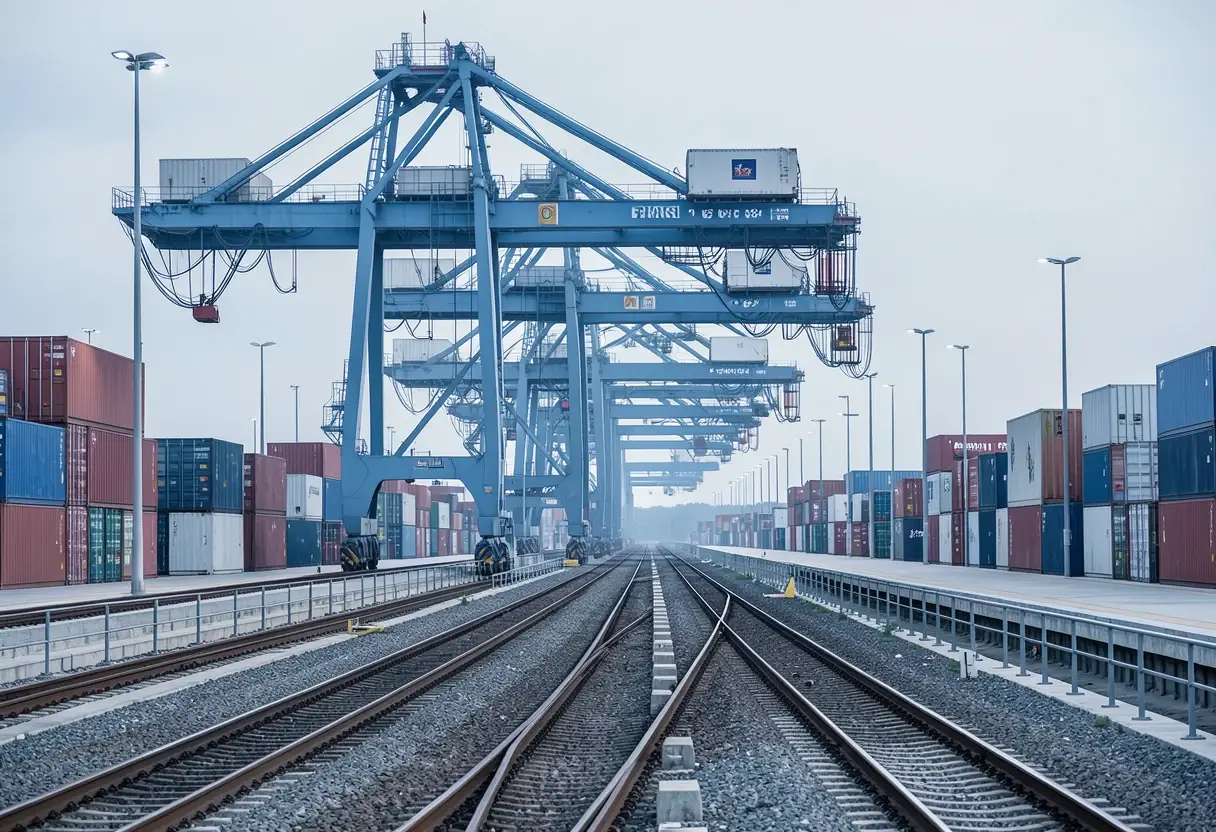
Euroterminal Sławków signed a PLN 88 million (€20 million) contract on 16 November to build a second container-handling area near Katowice, part of a roughly €43 million programme designed to add 198,925 TEU a year.
The terminal operator, which forms part of Poland’s state-owned Industrial Development Agency (ARP), signed the agreement with a consortium of Polish construction companies NDI and NDI Sopot. The facility, designated TK-2, will stand beside the existing terminal infrastructure.
Euroterminal Sławków lies near Katowice, where Poland’s 1,435 mm standard-gauge railway meets the 1,520 mm broad-gauge network used in Ukraine and other eastern countries. The location allows one terminal to handle freight moving on either gauge.
The terminal connects to the Broad Gauge Metallurgy Line (LHS), which runs almost 400 km from the Ukrainian border at Hrubieszów to Sławków. The project description says this allows broad-gauge freight trains to travel “deep into southern Poland without transferring their cargo at the Ukrainian border.”
What will Euroterminal build at TK-2?
TK-2 will occupy five hectares and include about four kilometres of railway tracks for train access and shunting. The works also cover internal roads, drainage, electrical installations, telecommunications and other supporting infrastructure.
The equipment package comprises:
- Two rubber-tyred gantry cranes
- Three reachstackers
- Two terminal tractors
Those additions underpin the stated handling-capacity increase. The announcement does not disclose an expected train frequency, handling rate per shift or change in terminal operating costs.
The source lists the incoming equipment but provides no existing fleet size, allocated train paths or corridor forecasts. It therefore cannot establish how quickly the expanded terminal could use all 198,925 TEU of additional allowance.
How much extra capacity is planned?
The additional allowance equals 198,925 twenty-foot-equivalent units (TEU) annually, while the announcement puts the existing terminal’s capacity at approximately 285,000 TEU per year. If both figures hold after commissioning, nominal capacity would reach 483,925 TEU, about 70% above the present level.
That remains a design parameter, not a measured throughput result. The announcement provides no recent cargo volumes, customer commitments or corridor forecasts against which to test the target. It also gives no tariff reduction or quantified saving in handling and rail costs, leaving capacity as the main stated service benefit.
What operational role does the gauge break play?
At Sławków, containers and other intermodal loading units can move between broad- and standard-gauge trains or onto trucks for onward distribution. The terminal serves as an inland gauge-break point, linking rail freight from Ukraine and Central Asia with European logistics networks and seaports.
This arrangement removes the need for eligible broad-gauge freight to change trains at the Ukrainian border, but it does not eliminate the gauge transfer inside Poland. No traffic split by gauge, customer or destination accompanies the contract, so the commercial effect of the new handling area remains unquantified.
When will the work start, and what funding is committed?
NDI was selected as construction contractor in October 2026, followed by the formal signing in November. Construction is scheduled to begin around the end of the first quarter of 2027, with completion planned for 2028.
About €17 million in EU funding under Poland’s FEnIKS infrastructure programme supports the project. The grant equals approximately 40% of the larger programme’s €43 million headline cost, although the announcement does not identify the balance or specify how much covers TK-2 rather than other expansion phases.
Railmarket reported in May 2025 that the programme also positions the terminal for a possible role in freight associated with Ukraine’s reconstruction. No dedicated reconstruction tonnage, reserved capacity or customer agreement accompanies the contract, so that role remains a possibility rather than booked traffic.
Euroterminal expects the expansion to create 26 additional jobs, including 13 handling-equipment operator positions. The announcement does not say when those roles will be filled or whether staffing will operate across one or multiple shifts.
The next measurable points are the start of works near the end of the first quarter of 2027 and the terminal’s subsequent ability to convert 198,925 TEU of design capacity into booked services and measured throughput by 2028.
via railmarket.com (Source)
More from Rebecca Stone
Show full bio
Senior reporter covering money, funding and market shifts around Rail industry news and analysis at Mainline Report.
384 articles
Connecting services · Related articles
- 22:23
Teleste lands €40m on-board systems deal for Copenhagen S-bane fleet
- 09:49
ÖBB Rail Cargo Group launches Łódź–Budapest intermodal service
- 24:10
METRANS lifts Gądki terminal capacity by 80% to 590,000 TEU
- 12:14
Łódź HSR tunnel: 4,000-tonne TBM assembly pushes 2027 boring date
- 22:35
Warsaw–Łódź high-speed bidder list cut to five of eight