24:54INPlt 7510 words
Delft tram extension opens after 20-year delay
HTM Route 19 reached TU Delft on October 5 after a €93m, 20-year project, using a patented power feed that cuts magnetic radiation near labs.
· 3 min journey
Calling at
- HTM opened Route 19 to TU Delft campus on October 5 after a 20-year project costing €93m.
- The 2·5 km extension has six stops, four on campus, with four trains per hour weekdays 07.00–19.00 and no evening service.
- Power cables run between the rails in a patented passive compensation system to cut magnetic radiation near labs.
- The design is already installed in Utrecht and Lund, with Wien planning an installation.
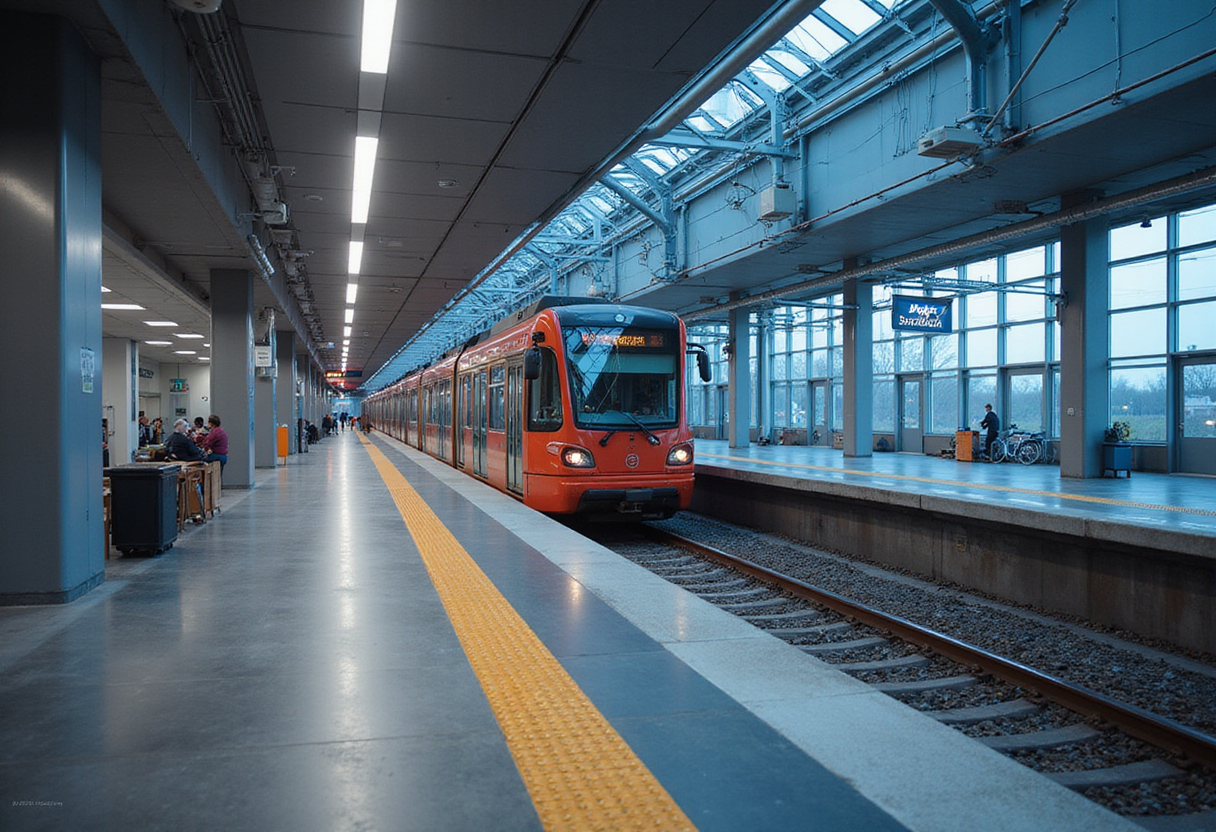
HTM launched tram Route 19 to the Delft University of Technology campus on October 5, completing a €93m project that took two decades because of electromagnetic interference risks to the university's research equipment.
The extension runs 2·5 km from Delft station to Schoenmakerstraat and serves six stops, four of them on the campus. It terminates halfway through the university site specifically to limit interference with experiments.
Services run four times per hour on weekdays between 07.00 and 19.00. There are no evening services, again to protect sensitive lab equipment.
Why did the project take 20 years?
The scheme required collaboration between HTM, Delft municipality, regional transport authority MRDH and TU Delft. Technical challenges and funding problems stretched delivery across two decades.
Initial plans stalled when new Siemens Mobility Avenio trams produced greater vibrations and magnetic radiation than expected. Contractors had to lift completed track and redesign the power supply from scratch.
Financial difficulties added to the delay, including a near-bankruptcy at Delft municipality. In 2023 a purchasing error led to incorrect cable specifications, forcing engineers to reorder custom parts. Total expenditure eventually reached €93m.
How does the power system protect the labs?
The engineering response covers both trackform and electrification.
- Rails sit in self-healling fibre reinforced concrete slabs with rubber insulation to damp vibration.
- TU Delft and EM Power Systems developed a passive compensation system: power cables feeding the overhead contact wire run between the rails rather than above them, reducing magnetic radiation along the route.
'You can see a huge amount of cables, which are all part of a passive compensation system,' EM Power Systems specialist Mark van Bekkum told SpoorPro. He explained that placing the power cables close together between the tracks means that 'over the long length, the magnetic radiation is greatly reduced.'
TU Delft patented the invention and earns revenue from cities that implement it. The system is already installed on Utrecht's Uithof Line and at Lund in Sweden; Wien is working on an installation, and Van Bekkum is advising other cities.
What does the opening change for passengers?
For the university community, the line removes a transfer from daily journeys to campus. Niels van Oort, a public transport researcher at TU Delft, said: 'A campus with international appeal benefits from high-quality public transport links.'
He noted the project's unusually long gestation. 'It also marks the conclusion of a research project I carried out myself as a student in 2002 into the tram's route. For me and many other lecturers, the history of the tram was also a rich source of material for lectures, including a call for necessary patience in our field. But I certainly won't miss that. Nor will I miss having to change trams on my daily commute. I can now enjoy a direct journey straight to the campus.'
With the compensation system now deployed in three countries and under study in Wien, the Delft design points to a wider market for interference-free tram electrification near sensitive research and medical facilities.
via spoorpro.nl (Original)
More from Rebecca Stone
Show full bio
Senior reporter covering business strategy at Mainline Report.
261 articles
Connecting services · Related articles
- 24:44
Kraków opens 4.5 km fast tram extension to Mistrzejowice
- 24:49
TransLink Begins Five Months of Overnight SkyTrain Testing
- 23:43
Siemens Puts Cloud Rail Signaling Into Live German Tram Service
- 13:30
Prasa completes probe into R17bn signalling tender
- 02:59
Ciulnița and Fetești Switch to Hitachi Rail's L90 RO Interlocking