10:18PAPlt 5582 words
China Opens Its Northernmost High-Speed Railway
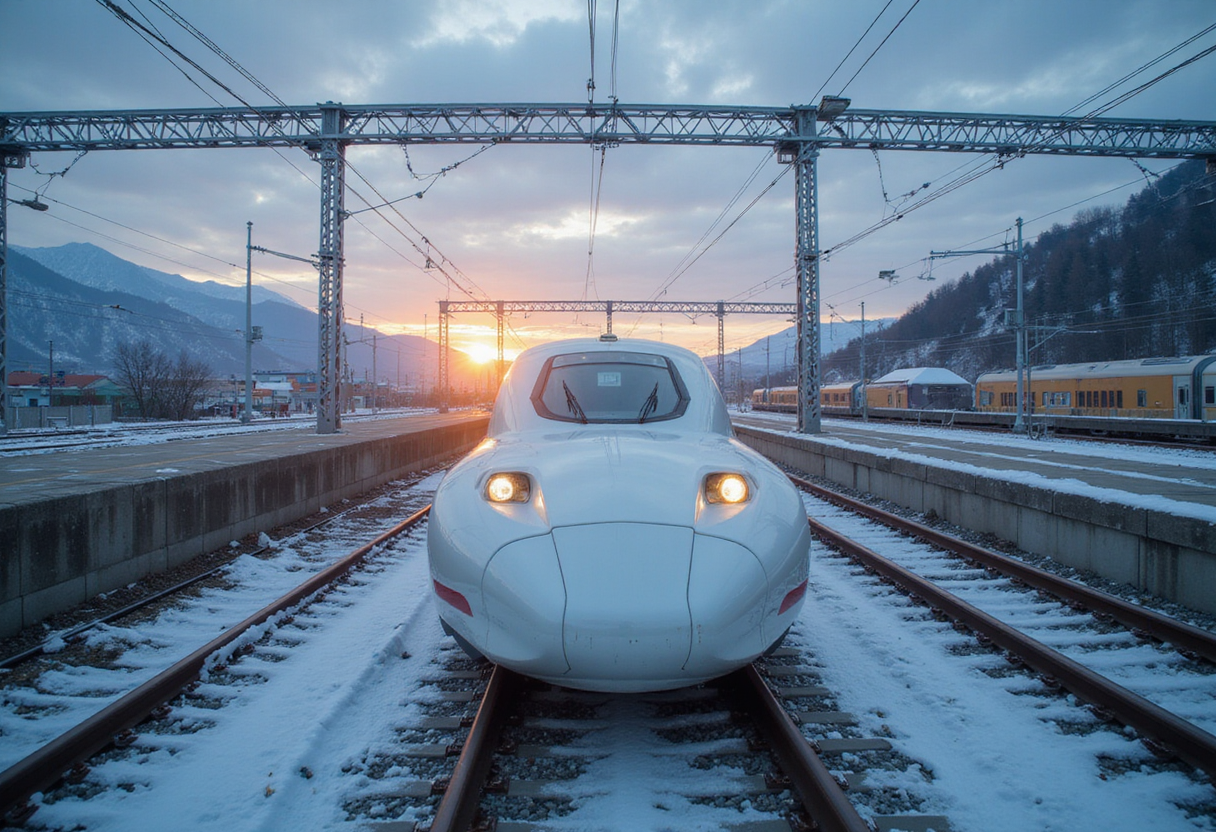
China has opened the northernmost high-speed railway on its network, extending fast passenger service toward the Siberian frontier and closing one of the last gaps in the world's largest HSR system.
· 3 min journey
Calling at
- China has opened the northernmost high-speed railway on its national network.
- The opening extends the world's largest high-speed network, now exceeding 45,000 route-km, into China's far northern frontier region.
- The line's first full winter of revenue service will test timetable stability in temperatures below minus 30 degrees Celsius.
China has opened the northernmost high-speed railway on its national network, pushing conventional passenger rail operating at high-speed standards closer to the country's frontier with Siberia.
The opening, reported by Nepali news outlet Ratopati, marks another incremental extension of what is already the world's largest high-speed network. For passengers in China's northernmost provinces, the significance is straightforward: the new line replaces long-distance conventional rail or road journeys with faster, higher-frequency service, cutting travel times between regional population centres and the national hub network.
China's high-speed rail network now exceeds 45,000 route-kilometres, a figure that has grown steadily under successive national rail plans. The northernmost corridors have historically been the last to be converted, reflecting lower population densities, severe winter operating conditions and higher per-kilometre construction costs than in the densely populated eastern and central provinces. An opening at the northern extremity of the network therefore represents the closing of one of the remaining gaps rather than the start of a new programme.
Winter operation remains the defining engineering constraint on any line this far north. Chinese operators have accumulated extensive experience running 350 km/h and 250 km/h services through Heilongjiang and Inner Mongolia, where temperatures routinely fall below minus 30 degrees Celsius. Switch heaters, rail tensioning systems and trainset door mechanisms all require cold-climate specification, and timetable planning accounts for slower accelerations and longer turnaround times in the deepest winter months. Any new northern line inherits that operating regime from day one.
The service outcome for passengers is measured in hours rather than minutes at this scale of geography. Journeys that once required overnight conventional trains or lengthy road transfers can be completed within a single day, which changes the practical economics of business travel, medical access to major hospitals, and tourism flows into northern regions that have marketed winter attractions such as ice festivals aggressively in recent years.
For the national operator, China State Railway Group, the northern extensions serve network-coverage and regional-development policy goals as much as they serve demand. Ridership on frontier lines typically starts below the levels seen on trunk routes such as Beijing–Shanghai, and the business case rests partly on the state's broader regional development objectives, including the revitalisation programme for China's northeastern provinces, which has struggled with population decline and slower industrial growth than the coastal south.
As with any opening announcement from an operator or its suppliers, the headline travel-time claims should be read against the published timetable once revenue service has settled. Chinese line openings routinely quote the fastest train of the day; average journey times across the full schedule can be meaningfully longer, particularly on newly opened lines where services are still being ramped up and connections with the existing conventional network are being tuned.
The opening also has a supply-chain dimension. Domestic manufacturers — CRRC and its component suppliers — dominate rolling stock provision for these lines, and northern extensions typically deploy trainsets already proven in cold-weather service rather than new designs. That limits the commercial news for suppliers but reduces commissioning risk for the operator.
Attention now turns to how the line performs through its first full winter of revenue service. Timetable stability in extreme cold, actual ridership against forecasts, and the integration of connecting conventional services will determine whether the northernmost link becomes a durable part of the network or a demonstration of coverage for its own sake.
via Google News: High-speed rail (Source)
More from James Calloway
Show full bio
Correspondent covering consumer brands and retail at Mainline Report.
150 articles
Connecting services · Related articles
- 07:13
China's northernmost high-speed line enters revenue service
- 08:43
China Puts Its Northernmost High-Speed Railway Into Service
- 22:28
China Puts Four New High-Speed Lines Into Service
- 10:18
High-speed line through central China's mountains enters service
- 11:48
China opens four new high-speed lines, extending national network