17:23SAPlt 9539 words
Wisconsin launches 'See Tracks, Think Train' safety campaign
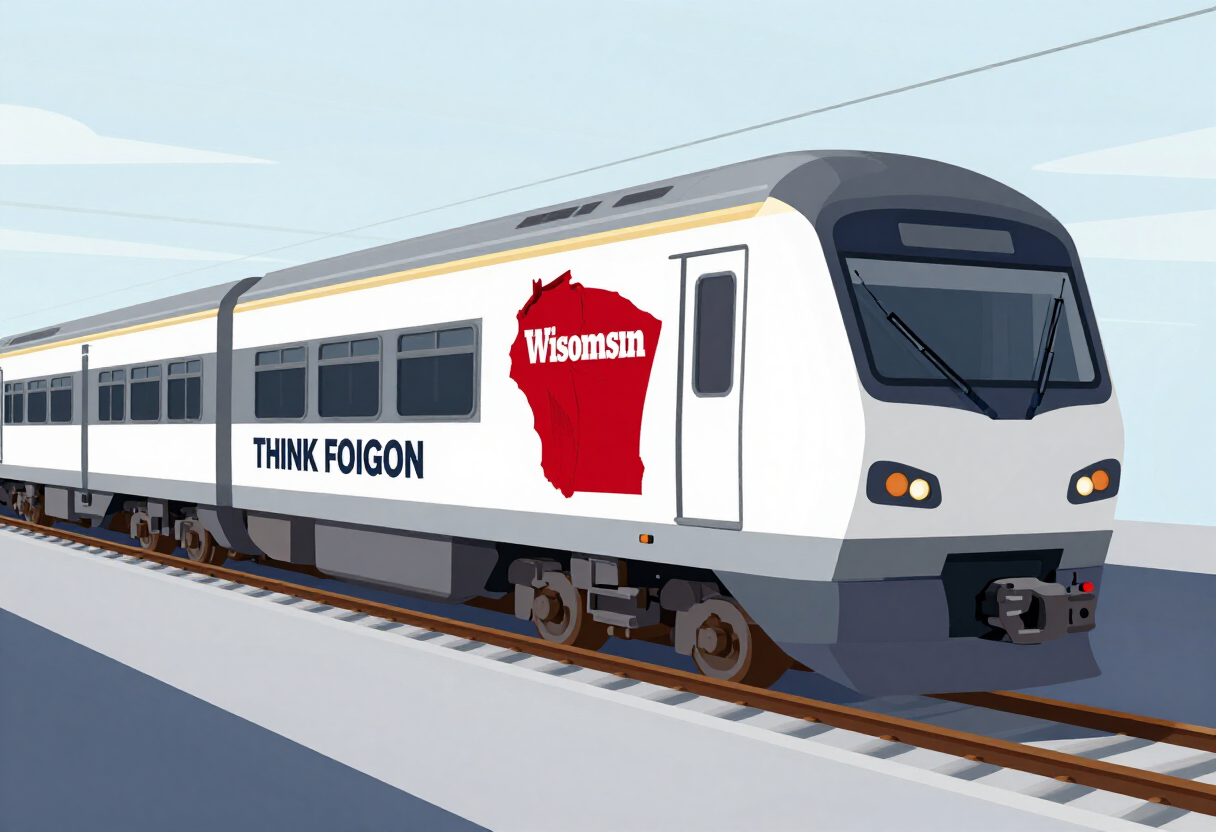
Wisconsin has launched the 'See Tracks, Think Train' rail safety campaign, targeting driver and pedestrian behaviour at level crossings to cut collisions and the service disruption they cause.
· 3 min journey
Calling at
- Wisconsin's 'See Tracks, Think Train' public safety campaign is under way
- The campaign targets driver and pedestrian behaviour at highway-rail crossings
- Crossing incidents block lines and delay freight and passenger movements, adding operational cost
Wisconsin has launched a rail safety awareness campaign under the banner 'See Tracks, Think Train', with the state's highway-rail interfaces as its focus.
The campaign is under way across Wisconsin, Spectrum News reports. Its title doubles as its core instruction to the public: when a driver or pedestrian sees tracks, the expectation is that a train may be using them, and behaviour should adjust accordingly.
Campaigns of this type are not marketing exercises for the rail sector. They are interventions aimed at a specific operational problem: collisions and near-misses at level crossings and incidents involving pedestrians on or near track. Each such event carries costs beyond the immediate human toll. A single crossing strike can stop a freight or passenger movement for hours, force an investigation, damage rolling stock and trigger regulatory scrutiny of the crossing itself.
For the Class I and regional freight operators that serve Wisconsin, and for any passenger services using the same corridors, the service consequence of a grade-crossing incident is immediate. Trains cannot deviate around an obstruction. A blocked line delays following movements, compounds congestion at junctions and, in the worst cases, requires rerouting across alternative routes that add hours to schedules.
That is the arithmetic that makes public-awareness campaigns attractive to both operators and regulators. Prevention at the crossing is cheaper than any of the alternatives: gated separation, closure, or the operational cost of repeated incidents. Grade separation works, but it costs millions of dollars per site and competes for funding with dozens of other crossings in any state network. An awareness campaign costs a fraction of one grade-separation project and can cover an entire state.
Wisconsin's rail network carries a mix of through freight, local switching operations and regional traffic, and its crossings sit in a range of environments: urban streets with high pedestrian volumes, rural crossings with passive signage only, and industrial spur lines where trains move slowly but frequently and unpredictably for road users.
The 'See Tracks, Think Train' framing targets the behavioural failure that investigation findings repeatedly point to in crossing incidents: road users treating tracks as inert infrastructure rather than as an active transportation corridor. Drivers who would never ignore a red light at a road junction routinely cross tracks without looking, on the assumption that no train is coming. The campaign message asks them to invert that assumption.
Spectrum News reports the campaign is now under way in Wisconsin. The outlet's report does not specify the campaign's duration, its budget, the agencies or operators backing it, or the specific metrics against which its effectiveness will be judged.
Those gaps matter, because awareness campaigns live or die on measurement. The trade standard is to track crossing collisions, fatalities and near-miss reports over a multi-year window, comparing incident rates before and after the campaign while controlling for changes in traffic volumes and network usage. A campaign that cannot show movement in those numbers is a communications exercise, not a safety intervention.
Whether Wisconsin's effort will be evaluated on that basis, and by whom — the state's rail safety regulator, the participating operators, or the campaign's own organisers — remains to be seen as the programme rolls out.
via Google News: Rail safety (Source)
More from James Calloway
Show full bio
Correspondent covering consumer brands and retail at Mainline Report.
150 articles
Connecting services · Related articles
- 22:33
Iowa Campaign Targets Motorist Safety at Rail Crossings
- 15:05
Indiana Marks Rail Safety Week as State Observes Annual Campaign
- 15:20
Iowa launches Rail Safety Week to cut motorist deaths at crossings
- 15:35
South Carolina reports dozens of crossing collisions as Rail Safety Week opens
- 15:05
NCDOT pushes rail crossing safety message during safety week