23:43INPlt 12821 words
Survey Signals Growing European Discontent With Rail
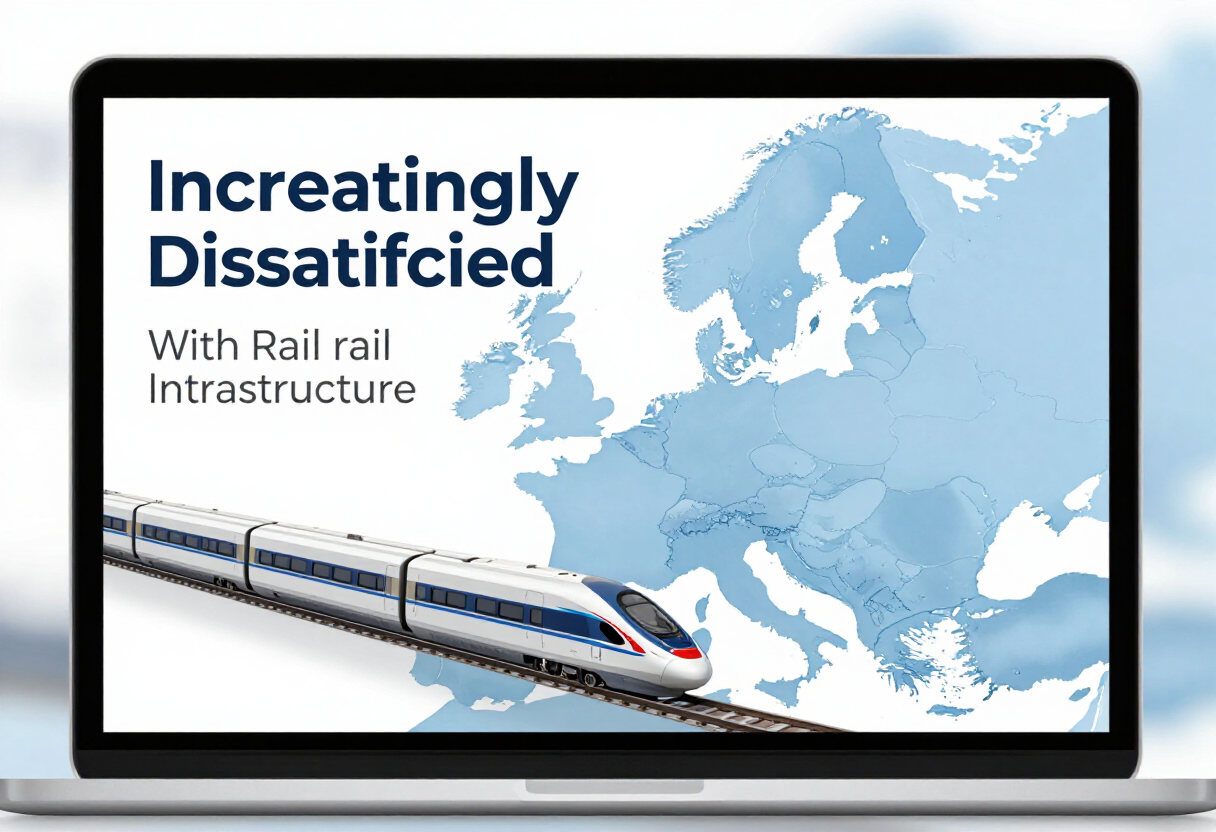
Megaproject.com reports rising European dissatisfaction with rail infrastructure, exposing a gap between investment promises and the passenger experience on the network.
· 4 min journey
Calling at
- Megaproject.com reports that European public dissatisfaction with rail infrastructure is increasing.
- The report does not disclose survey methodology, sample size or national breakdown, so the claim remains unverified against official satisfaction indices.
- The trend, if confirmed by official punctuality and satisfaction statistics, would carry political risk for future rail funding programmes across European networks.
Public dissatisfaction with rail infrastructure is growing across Europe, according to a report published by megaproject.com. The finding, while thinly documented in the source material now circulating through news aggregators, points to a gap between the political emphasis on rail as the backbone of European decarbonisation policy and the day-to-day experience of passengers and freight users on the network.
The headline claim — that Europeans are increasingly dissatisfied with rail infrastructure — arrives at a moment when European institutions and national governments are directing unprecedented funding toward rail. The question the report raises, and which network operators and regulators will need to answer, is whether that investment is reaching the assets and services that shape passenger experience quickly enough to alter public perception.
What the report asserts
The megaproject.com item asserts a trend: dissatisfaction is rising. It does not, in the form distributed via Google News aggregation, publish the underlying survey instrument, sample size, national breakdown or margin of error. Readers should treat the claim accordingly — as a directional signal rather than a measured, audited result. Trade practice requires that any satisfaction figure be checked against the methodology before it is compared with established indices such as the European Commission's own passenger satisfaction reporting.
That caveat matters, because dissatisfaction with infrastructure is not uniform across Europe. Operators in Switzerland, the Netherlands and parts of Scandinavia routinely post satisfaction levels that operators in other markets do not match. A continental average can conceal as much as it reveals.
Why the claim is plausible
Even without published figures, the reported trend is consistent with pressures visible across the network. Years of deferred maintenance on secondary lines, engineering works that suppress punctuality statistics, and capacity constraints on core corridors all feed directly into the passenger experience. When infrastructure ages faster than renewal programmes deliver, satisfaction falls — not because service operators fail, but because the asset base under them degrades.
Cost outcomes follow the same logic. Delay-minute compensation, revised timetables and bus replacement services carry real prices for operators and passengers alike. Freight shippers respond to unreliable paths by shifting volume to road, which in turn undermines the modal-shift targets that European transport policy has set for this decade.
The investment context
European rail investment is substantial by any historical measure. National recovery plans channelled tens of billions of euros into rail, and cross-border corridors under the Trans-European Transport Network framework continue to attract committed funding. Yet the megaproject.com report suggests that money committed and satisfaction delivered are not the same thing — a distinction that matters for every infrastructure manager from DB InfraGO in Germany to SNCF Réseau in France and RFI in Italy.
Germany illustrates the point. Despite record federal commitments to its generalised rail renewal programme, the network's punctuality performance and construction-related disruption have kept user frustration high. France and the United Kingdom face their own renewal backlogs on legacy assets, while Central European networks juggle modernisation needs against constrained public budgets. In each case, the operational change passengers notice — a renewed line, a faster frequency, a punctual train — arrives years after the funding announcement.
What operators and regulators should watch
If the reported dissatisfaction trend holds, it carries consequences beyond reputation. Political support for rail funding depends in part on public experience: voters who find rail unreliable are less likely to back the next multiyear investment envelope. Regulators and infrastructure managers therefore have a direct stake in converting capital programmes into visible service outcomes — measured in punctuality, journey time and network availability — rather than in groundbreaking ceremonies.
For suppliers, sustained dissatisfaction can cut both ways. It may signal renewal demand that supports order books for signalling, track systems and rolling stock. It may also signal a funding environment in which governments redirect money toward visible quick fixes at the expense of the deeper asset renewals that raise capacity over decades.
The evidentiary gap
The megaproject.com report, as currently available, does not name the survey's sponsor, field dates, sample or national coverage. Until those details are published, the figure should sit in the claims column, not the measured-results column. Established European satisfaction benchmarks, where they exist, come with published methodologies and longitudinal baselines that allow year-on-year comparison.
What the report does establish is that the narrative of rail dissatisfaction has enough traction to circulate widely through industry channels — and that traction itself is data. Operators preparing annual reports and infrastructure managers defending budget requests should expect journalists and legislators to cite this trend.
Outlook
The report's forward implication is straightforward: European rail must close the gap between investment promises and passenger experience before dissatisfaction hardens into political resistance. The next measurable test will come from the official punctuality and satisfaction statistics that infrastructure managers and the European Commission publish for the current reporting year; those numbers, not headlines, will confirm or refute the trend megaproject.com describes.
via Google News: Rail infrastructure and investment (Source)
More from Olivia Hart
Show full bio
Market editor covering industry trends and analytics at Mainline Report.
149 articles
Connecting services · Related articles
- 14:30
Survey finding points to growing European dissatisfaction with rail
- 16:00
European Rail Policy: The Road Ahead for the Continent's Network
- 09:15
Are We Repeating Britain's High-Speed Rail Mistakes?
- 05:45
Europe Must Lead Next-Generation High-Speed And Digital Rail
- 10:18
Poland's High-Speed Rail can help deliver Europe's vision