24:44SAPlt 9795 words
Elstow collision: 79 km/h SPAD ends 27-year record without fatal UK signal-overrun
A 79 km/h SPAD collision at Elstow on 19 June killed a driver and broke the UK's 27-year record without a fatal signal-overrun accident. The signal had no TPWS fitment.
· 4 min journey
Calling at
- Train 1H46 (Class 360) passed a red signal and hit Train 1B67 (Class 810) at about 79 km/h at Elstow on 19 June, killing one driver
- The Elstow signal was not fitted with TPWS; national coverage is now around 40% of signals, up from 30% in 2003
- Network Rail-era fatal passenger accidents (2003–2026) were 17% of the 1980–2002 count; fatalities were 8%
- Broken rails fell from 952 in 2000 to 70 in 2023/24; fewer than 100 mechanical signalboxes remain from about 3,000 in 1980
- EN15227 requires collision resistance at 36 km/h; the Elstow collision energy was four times that limit
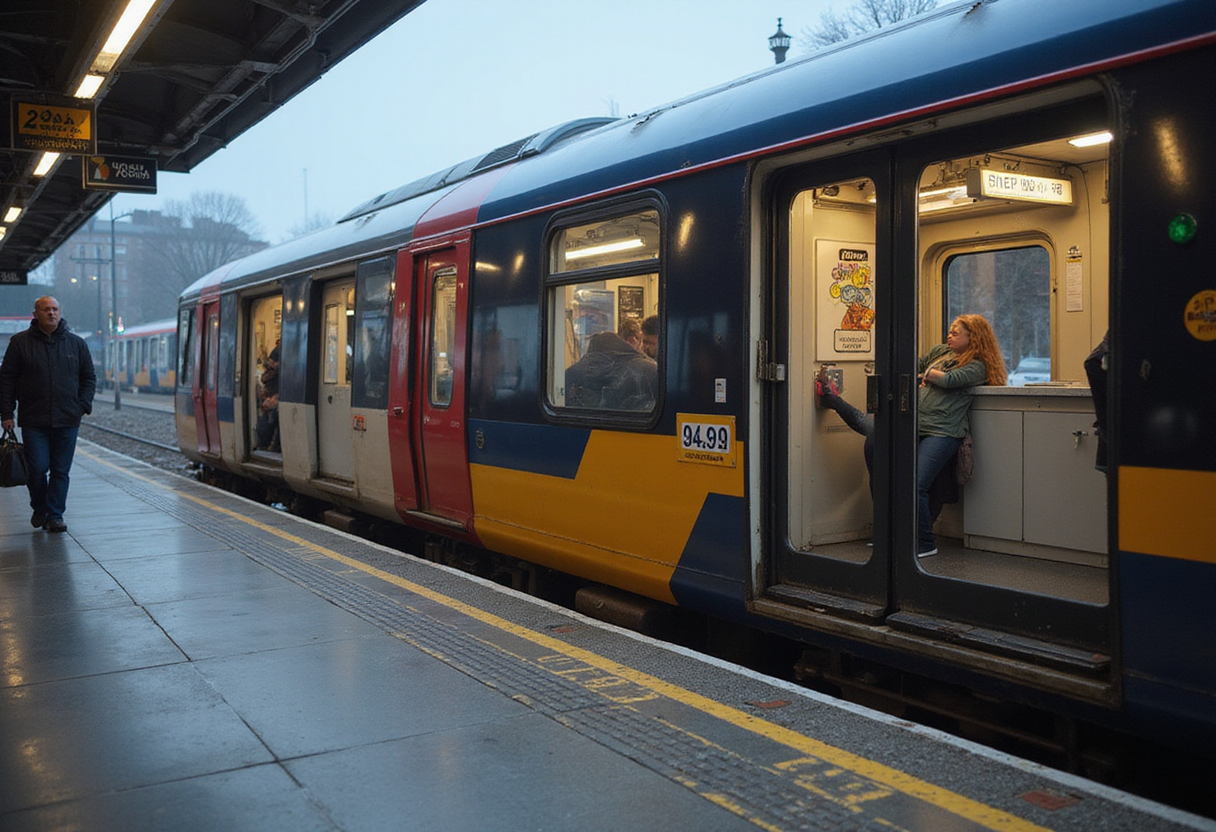
A four-car Class 360 EMU passed a signal at danger and ran into the rear of a stationary five-car Class 810 at approximately 79 km/h near Elstow, south of Bedford, on 19 June, killing a driver and leaving many passengers with major injuries. Three days later, the Rail Accident Investigation Branch (RAIB) confirmed the basic sequence: Train 1H46, formed of a 2003-built Class 360 unit, struck Train 1B67, a brand-new Class 810.
The signal passed at danger (SPAD) was not fitted with the Train Protection and Warning System (TPWS). That fact alone is likely to put TPWS fitment criteria on RAIB's investigation agenda, because the last fatal SPAD accident before Elstow was Ladbroke Grove in 1999 — a 27-year gap.
What ended the driver-error assumption?
Historic accident reports typically concluded that "the driver was driving without due attention to the signals". The source analysis rejects that framing. Passing a red signal is the immediate cause, not the whole story: causal and underlying factors across the organisations involved will not be known until RAIB publishes its full report, which will also carry recommendations to prevent a recurrence.
How much has UK train safety actually improved?
Between 1980 and 2026, the UK recorded 34 fatal passenger train accidents. Network Rail has existed since October 2002 — almost exactly half of that 46-year period — allowing a direct comparison:
- In the Network Rail era (2003–2026), fatal passenger train accidents were 17% of the British Rail/Railtrack era count (1980–2002)
- Fatalities from such accidents were 8% of the earlier period
- Fewer fatalities per fatal accident reflect improved train crashworthiness
- Between 1980 and 2002 there were 11 fatal SPAD and buffer-stop collisions — roughly one every two years — before TPWS and professional driving training took effect
The 1999 Railway Safety Regulations mandated TPWS at signals protecting passenger junctions, buffer stops, and speed reductions of 30% or more from initial speeds above 60 mph. When the programme completed in 2003, more than 12,000 signals — around 30% of the national total — had been fitted. Signal risk assessments and resignalling have since raised coverage to about 40%. Elstow's signal was in the unfitted majority.
Is the risk profile shifting?
Analysis of 69 passenger train accidents causing major injuries since 1980 shows categories rising since 2002:
- Level crossings (25% of the total)
- Earthworks failures (15%)
- Poor adhesion (10%)
- Collisions during signalled moves (10%)
Climate change pressures 150-year-old earthworks and may worsen low adhesion, as milder, wetter autumns and longer growing seasons increase vegetation. Though UK level-crossing incident rates sit well below the European average, there were 67 train collisions with vehicles on level crossings in the 10 years to 2023.
Categories that fell include broken rails, train defects and signaller error. Broken rails dropped from 952 in 2000 to 70 in 2023/24. Around 3,000 mechanical signalboxes have closed since 1980; fewer than 100 remain as Network Rail works toward controlling the network from 12 Regional Operating Centres.
Did crashworthiness perform at Elstow?
Rear-end collisions at roughly 80 km/h are rare, so comparisons reach back to Shields Junction (1973, closing speed 82 km/h, a Class 303 EMU crushing under Class 126 DMUs), Hassocks (1978, 76 km/h, where the rear train's first coach passed under the front train's last three coaches) and Clapham Junction (1988, 56 km/h), where Mark 1 underframe construction allowed passenger compartments to be breached, producing a high death toll.
At Elstow, by contrast, no passenger compartments appear to have been breached and both trains remained upright. One bogie derailed without blocking the adjacent line. The source judges this as strong performance against those precedents, and the collision energy context is stark: standard EN15227 requires main line trains to withstand a collision at 36 km/h — the 78 km/h Bedford collision carried four times that energy. RAIB may still draw crashworthiness lessons, particularly on coach interiors, considering the effects on passengers of a train brought to a dead stop.
Can the industry keep learning?
RAIB's 2025 annual report flagged overspeeding, asset integrity and level crossings as recurring themes putting trains at risk. Wrong-side signalling failures recurred at Cardiff (2016), Waterloo (2017), Dalwhinnie (2021) and Wingfield (2022), nearly four decades after Clapham shocked the S&T community. The report into 2023 overspeeding at Peterborough's Spital Junction found lessons from a similar 2022 incident had not been learned.
RAIB also cautioned that an absence of high-consequence accidents is not itself proof of safety, since the difference between a near miss and a serious accident can be luck. Its Elstow report, with findings on TPWS fitment, causal factors and crashworthiness, will define what changes next for UK passenger safety.
via grn.ams3.digitaloceanspaces.com (Original)
More from Amara Osei
Connecting services · Related articles
- 24:54
UK RAIB publishes interim findings on Elstow collision inquiry
- 12:35
AAR reports freight rail industry posted record safety performance in 2025
- 24:49
Senate Commerce panel opens review of passenger rail safety, PTC mandate
- 15:05
NTSB Officials Tell Chicago Audience U.S. Rail Safety Gaps Remain
- 15:05
CSX Points to Faster Emergency Response as Safety Driver