15:53PAPlt 6514 words
Brightline Proves Demand for Trains. The Funding Question Remains
Brightline's Florida ridership proves US demand for intercity rail, but Grist asks who will finance the next corridors as federal, state and private funding decisions loom.
· 3 min journey
Calling at
- Brightline's Florida service linking Miami and Orlando has demonstrated strong passenger demand for US intercity rail
- Grist's analysis argues the open question is financing, not demand, for expanding US passenger rail networks
- Future corridor expansions depend on federal, state and private funding structures rather than ridership proof of concept
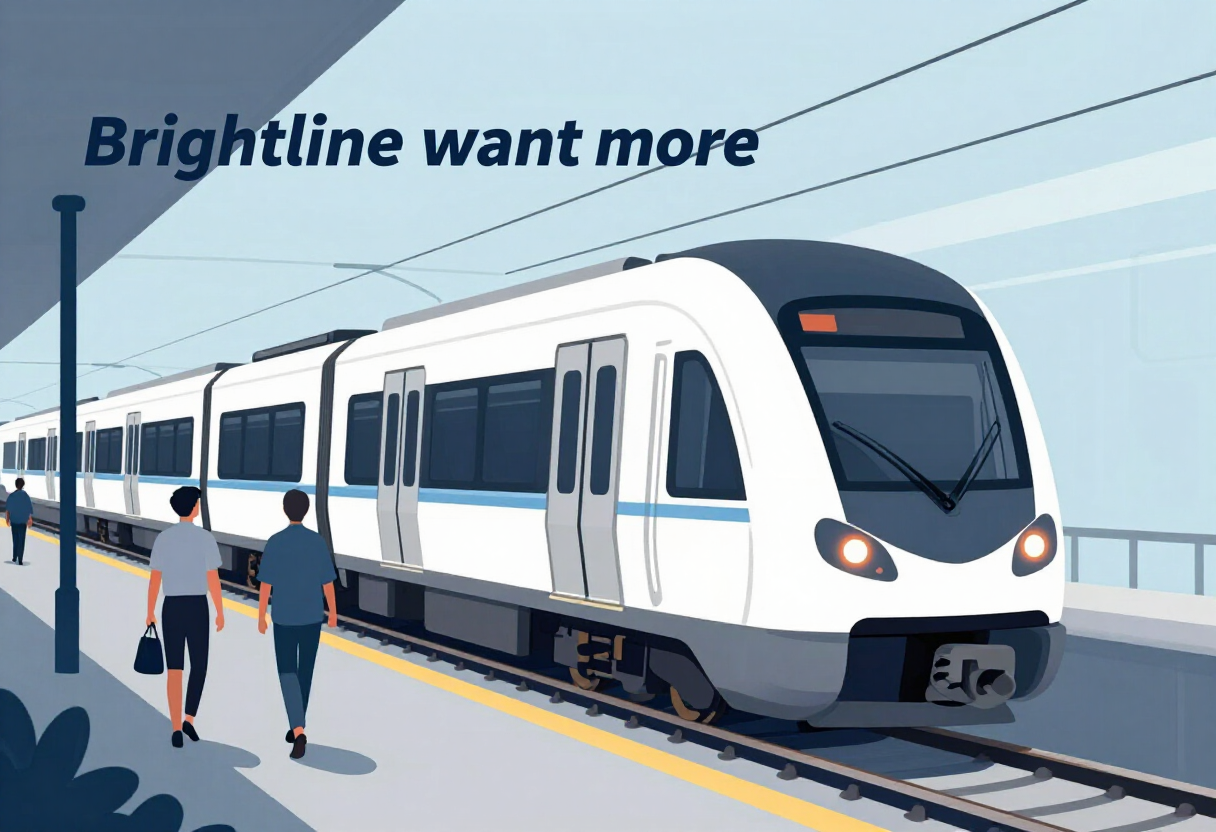
Brightline, the privately operated intercity passenger service in Florida, has demonstrated that Americans will ride trains when the service is fast, frequent and competitively positioned against driving and short-haul flights. That is the central finding framed in a new analysis by Grist, which asks a harder question now hanging over US passenger rail: if demand exists, who will finance the networks to serve it?
The Grist piece positions Brightline as a proof of concept. The service, which links Miami with Orlando via stations including West Palm Beach, has built its business on corridors dense enough and long enough that rail can capture trips from highways and airlines. Its performance has become a reference point in the debate over where US intercity passenger rail goes next — a debate that runs through Washington, through state capitols and through the private capital markets.
The funding question is the crux. Brightline's model — private capital, real estate development around stations, and corridors selected for revenue potential — does not transfer automatically to routes with weaker demographics or longer payback periods. As Grist frames it, the service shows that the demand side of the equation can work. The supply side, meaning the cost of building and operating new lines, still requires a funding answer that private operators have so far given only selectively.
Public money is one candidate. Federal programmes, including the infrastructure law's passenger rail accounts, have put billions of dollars behind corridor development, and state governments from California to North Carolina continue to fund intercity services operated in partnership with Amtrak. Yet each of those commitments carries political risk, multi-decade timelines and cost exposure that private capital generally refuses to shoulder alone.
Private capital is the other candidate, and Brightline's owners have shown willingness to commit it where the underlying corridor economics support the investment. The constraint is that few US corridors replicate the conditions that made the Florida investment viable: trip lengths in the two-to-four-hour range, congested road alternatives, strong downtown endpoints and developable station real estate.
The Grist analysis also touches on the broader political context. Support for passenger rail has grown, but translating enthusiasm into concrete financing — through federal grants, state match commitments or private equity — remains the bottleneck. Ridership on existing services, Brightline included, strengthens the case. It does not by itself close the funding gap for the next project.
For the operators, suppliers and public agencies watching the US market, the lesson is twofold. First, demand for high-quality intercity rail is no longer hypothetical; a private operator has shown riders will come. Second, each proposed expansion will be judged on its own financial structure, and the question of who pays will determine which corridors advance and which remain studies on a shelf.
Grist concludes that Brightline's success reframes the national conversation: the argument is no longer whether Americans want trains, but how the country intends to fund them. How federal, state and private funding decisions unfold over the coming budget cycles will shape whether the Florida model remains an outlier or becomes a template.
via Google News: High-speed rail (Source)
More from Olivia Hart
Show full bio
Market editor covering industry trends and analytics at Mainline Report.
149 articles
Connecting services · Related articles
- 18:53
Brightline Bankruptcy Puts US Private Passenger Rail Financing on Trial
- 15:50
Brightline Florida Files for Bankruptcy; Las Vegas Rail Delayed
- 15:50
Brightline West Future Questioned as Florida Rail Finances Falter
- 08:23
Brightline to File for Bankruptcy After Multiple Deaths: Reports
- 11:55
Clouds Gather Over Brightline's Las Vegas High-Speed Rail Project