09:38SIPlt 7601 words
Barrackpore Rail Signalling Upgraded to Withstand Flooding
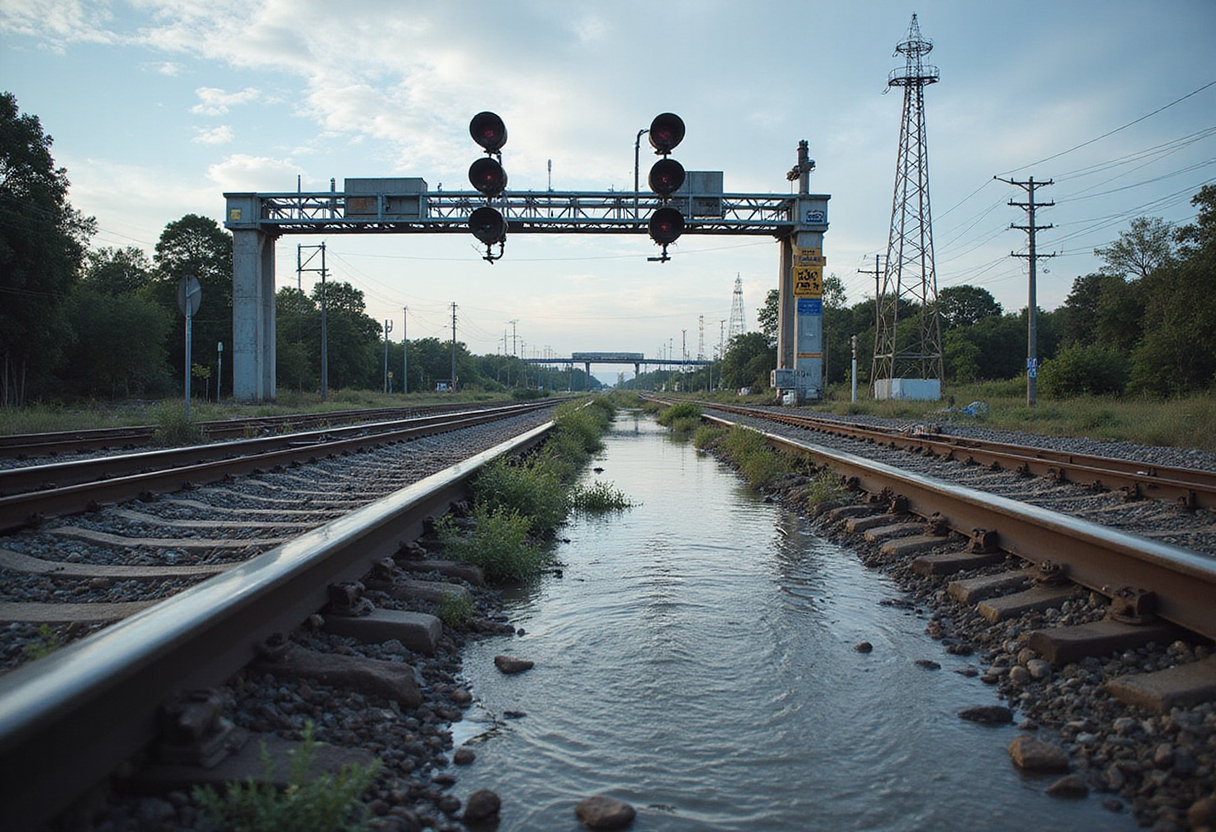
Signalling on the Barrackpore suburban corridor has been upgraded to withstand monsoon flooding, aiming to prevent water-induced failures that disrupt Sealdah-area train services.
· 3 min journey
Calling at
- Rail signalling on the Barrackpore section has been upgraded specifically to resist flooding, per urbanacres.in
- Barrackpore lies on the dense Sealdah–Barrackpore–Naihati suburban corridor in the Hooghly river basin, a monsoon-flood-prone area
- The report gives no supplier, cost, or completion date; effectiveness will be tested in the upcoming monsoon season
Rail signalling on the Barrackpore section has been upgraded specifically to resist flooding, according to a report from urbanacres.in. The headline claim marks the latest in a series of infrastructure measures Indian Railways has taken to keep suburban and main-line services running during the monsoon season, when waterlogged equipment has repeatedly forced signalling failures and speed restrictions across the network.
The upgrade addresses a persistent operational weakness. Conventional signalling equipment — relay cabinets, track circuits, point machines and cabling housed in ground-level locations and cabins — is vulnerable when floodwater inundates the lineside. When a track circuit fails or a signal goes blank, trains must halt or proceed at heavily restricted speeds under written instructions, which collapses throughput on busy suburban corridors. By hardening the signalling at Barrackpore, the operator aims to keep trains moving, and moving at line speed, through periods of heavy rainfall that would previously have degraded or suspended the service.
Barrackpore sits on the Sealdah–Barrackpore–Naihati suburban corridor in West Bengal, one of the densest commuter routes in the country and part of the Eastern Railway network. Sections of this corridor run through low-lying terrain along the Hooghly river basin, where monsoon flooding is a recurring seasonal event rather than an exceptional one. For daily commuters on the route, the practical measure of any signalling investment is simple: whether the timetable survives a downpour without collapsing into 20- and 30-minute gaps between trains.
The engineering logic behind flood-resilient signalling is well established on Indian Railways. Typical measures include raising relay rooms and equipment cabinets above anticipated high-water marks, relocating critical apparatus to elevated or waterproof enclosures, waterproofing cable joints and ducts, and installing components rated for immersion or high humidity. Comparable flood-proofing work has been carried out on other monsoon-affected sections of the network in recent years, and Eastern Railway has treated monsoon preparedness — which also covers track drainage, bridge scour checks and OHL maintenance — as an annual pre-season exercise.
The service and cost outcomes follow directly from the engineering. Every signal failure caused by water ingress translates into delayed trains, longer turnaround times at terminals, and knock-on disruption across the suburban network, because the corridor has little slack in its pathing. Hardened signalling reduces the frequency of those failures, which means fewer unscheduled stops, more reliable headways, and lower costs from emergency maintenance callouts and crew overtime. For a suburban operation running at near-capacity frequencies, protecting the signalling is effectively protecting the entire timetable.
As with any supplier or operator announcement, the claim should be read against the test of the next monsoon. The announcement itself asserts that the upgrade will beat flooding; the measured result will only become clear when heavy rainfall tests the equipment in live service, and when the section's failure and punctuality statistics for the season are compared against previous years. Indian Railways publishes such performance data zone by zone, and Eastern Railway's monsoon-period figures will show whether the Barrackpore investment has translated into measurably fewer weather-related signalling failures.
The report from urbanacres.in does not detail the specific suppliers, the cost of the works, or a completion date for the project, and these details would be needed to place the upgrade fully in context. What the announcement does establish is the intent: a flood-resilient signalling installation at Barrackpore, delivered ahead of the season in which it will be needed most. If the equipment performs as claimed, commuters on the Sealdah–Naihati corridor should see the benefit at the first serious rainfall of the coming monsoon.
via Google News: Rail signalling (Source)
More from Priya Raman
Show full bio
Staff writer covering consumer brands and retail at Mainline Report.
127 articles
Connecting services · Related articles
- 13:25
First passenger train runs under digital signalling on East Coast Main Line
- 16:15
Modi Defends Rail Build-Out, Targets Congress On Corridors
- 14:05
Signalling failure between Ore and Eastbourne disrupts Southern services
- 21:08
BMRCL secures rolling stock approval for Pink Line trains
- 14:20
Funding extension approved for Quad Cities passenger rail project